How do you fit a master's degree around a demanding career, family life, and everything else competing for your time?
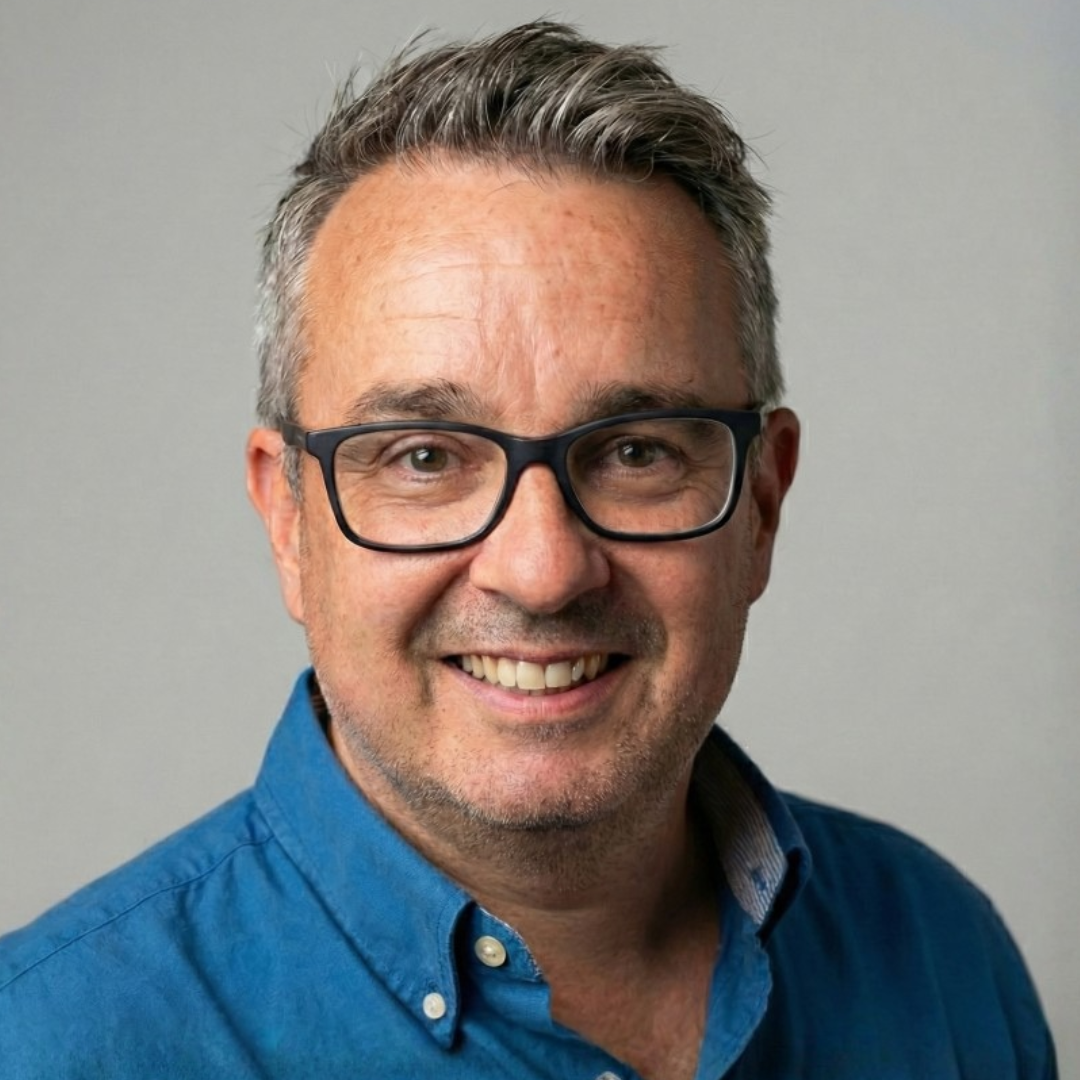
Neil Letchford, Vice President of Digital Engineering at Virgin Atlantic, is doing exactly that on Southampton's online MA in Artificial Intelligence. In part two of this Q&A series, he shares his experience of returning to study while working full-time.
Course Adviser Declan also explains how the programme's flexibility can accommodate changing commitments, from work travel to family emergencies.
Together, they offer practical insight into what online postgraduate study involves.
As a busy working professional, how do you find the part-time element? How are you fitting your studies in with your working schedule, family, social life and everything else?
NEIL: The time commitment is probably the biggest challenge. At the end of the day, it’s a master’s, and there’s a level of academic rigour there. I have a demanding full-time job and family, so the hardest part has been finding that protected study time.
Blocking time out during the week or at the weekends has been the hardest part, but I've had great support from my family to do that. For those of you looking to do the course, you have to be realistic that during evenings and weekends, you will need to spend time reading and working on your assignments.
When it came to thinking about those deadlines, I found it really useful to think of them like work deadlines. In the same way I would schedule time to work towards a deadline, I block the time out. I do the same with my modules. It’s a lot of work, and it’s relentless, but what I'm getting out of the course has been fantastic.
I travel a lot for work. What happens if I'm away for a week, or if I have a family emergency?
DECLAN: The programme's flexibility allows you to keep in a strong direction moving forward but also accommodate the challenges that life throws at you.
NEIL: I agree - the pace is quite set, and it is busy. But you do have flexibility within the week to choose what, where, and when you'll study.
For example, my son now plays hockey. I sit in the car and do my reading for the week because I have two hours to spare. You'll find time. Equally, when I fly for Virgin Atlantic, I love it because I have eight hours of unrestricted reading time.
DECLAN: You can access Blackboard so easily through your tablet, your phone and your laptop, so you can take your study with you wherever you go.
Do you feel connected to your fellow students on the course?
NEIL: Yes, I do. I've made friends with the people I'm learning with, and we're connected on WhatsApp groups. In fact, just this week I met someone from my tutor group for a coffee in my office. They popped over to say hello and we talked AI. You will make contacts and meet people.
What has surprised you most about the programme, either positively or negatively?
NEIL: The positive thing that I've been surprised about is just how much I've enjoyed studying again.
It's one of the best things I've done in my career. I'm absolutely loving studying again, reading around the subject and just learning; it's been such a positive experience for me.
You have to accept that sometimes, you won’t fully understand what you're meant to be doing as part of a module. And you’ll have to go and spend more time talking to a tutor or getting advice.
I'll admit – when I first started, it did feel quite overwhelming when we talked about Harvard referencing and things of that nature. You get access to the library and you're like, "oh my God, how am I going to figure out how to do anything?".
But you get there. The negatives are nothing in comparison to the positives.
What advice would you give someone starting online study who wants to get considerably more out of it than simply earning the degree?
NEIL: This isn’t just a degree. You must be interested in the subject. To get the most out of it, I would say you should investigate as deeply as possible. When I first started, our tutors spoke to us about the point of the master’s, and where the modules lead. So, they’re not an end point – they're the starting point. The purpose of the master's is to point you in a direction, and then you go out and complete your own academic study and your own reading. You won’t be drip-fed a standard course. This is about your own study, investigation and reading around the subject.
Once you're on the course, make friends, build contacts. That's been brilliant as well - meeting lots of people from lots of different industries, connecting on LinkedIn. Some students meet up and go to pubs and seminars.
Are there exams or any specific times where you'd need to be available?
DECLAN: No, there are no exams. They don’t fit in with our flexible learning plan.
However, we would always encourage people to join the live weekly webinars because they're a very positive experience in terms of networking, speaking with the faculty, great opportunity to ask questions, talk through the topics and gain that deeper understanding.
I'm worried it's been too long since I did my degree. Is there a big learning curve returning to studies after so long?
NEIL: I think it all comes down to attitude. I believe that if I were younger, I wouldn't have been as successful on this master's degree as I am now that I'm older. The life experience I've had, and my career experience, has paid dividends in how I'm approaching this master's. So, I don't see that as a blocker.
DECLAN: We have a really broad age range. I think the oldest student we've supported joining one of our programmes was in his mid- to late-70s. AI was just something that he was very much interested in. So, he asked himself, “why not just pay some money and learn more about it.”
We also have a number of people coming directly from studying at an undergraduate level. I think it's nice to have that balance of workplace experience and recent academic experience.
We have people who've gone through our performance pathway. They haven't done a degree before, so they've come in through an experiential route.
We're very inclusive in terms of nationality, too. We have students from Australia, Canada, South America, a number from Europe, Gulf countries, and Africa.
Likewise, there's a great gender balance – and AI is a good example of this. We see so many women looking to move into technology from this perspective, and it's fantastic that we can champion such an inclusive programme.
Roughly what is the expected weekly time commitment for a course?
DECLAN:
The Competition and Markets Authority govern the response on this. The advice is that for every credit you study at level 7, which is master’s level, you should dedicate 10 hours of study. So, the advertised hours for study and the hours that we advise you on roughly total up to 150 hours per module.
NEIL: For me, it depends on the module. It also depends on where you are in the course. Generally, when you're coming up to an assessment and writing a paper, you're spending a lot more time on it. But normally, I will spend one or two evenings a week doing my reading and watching the lecturers.
We have tutorials, which I usually attend. I try and get a Friday tutorial or watch it then. And normally, I would spend maybe a Sunday morning or afternoon working as well. Broadly, that's the average.
Has your employer given you time to study?
NEIL: No, they haven't. Unfortunately, in my role, it's all on me – it was my choice to do this. So, I don't get study leave. However, there are others in my company who are doing master's degrees and other postgraduate study and do get time off. It really depends on your situation or your conversation with your manager.
Returning to study alongside work and other commitments takes planning, discipline and a willingness to make time for learning. With flexibility built into the programme, it's possible to find an approach that works around your own responsibilities.
Explore our MA in Artificial Intelligence