What does it take to study artificial intelligence while working in a demanding senior role? Neil Letchford, Vice President of Digital Engineering at Virgin Atlantic, is doing exactly that.
In this Q&A, he shares why he chose Southampton’s online MA Artificial Intelligence and what drew him to its broader approach. Joined by Course Adviser Declan Tonks, he also discusses what it's like to study the subject without a programming background. Most importantly, Neil explains how his learning is already shaping AI practice at Virgin Atlantic, from responsible AI to building an AI engineering team.
Neil, can you tell us a bit about yourself?
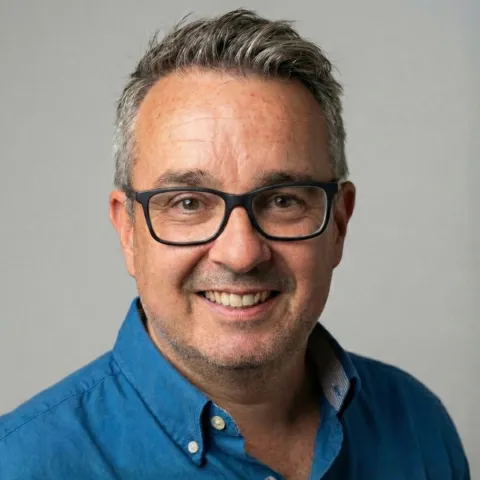
NEIL: Hi, I'm Neil Letchford. I'm the Vice President of Digital Engineering at Virgin Atlantic. I'm responsible for all our customer facing digital technology, i.e., the website, the mobile app and booking systems, et cetera. And increasingly within my job, artificial intelligence.
I'm a student here on the master's in Artificial Intelligence at Southampton, and I joined in September last year. I remember those initial sessions where we talked over what the course is, its context, how it might fit in with my day job, and how the studying would go. And we had quite a lot of discussions about how it would feel being part of the course.
Why did you choose to study Artificial Intelligence at the University of Southampton?
NEIL: What I found is that AI and its application were becoming a much bigger part of my day-to-day work, and this is the case for all of us. It got to the point where I wanted to go past the surface-level understanding of AI technology.
I'd exhausted the Twitter feeds, the LinkedIn posts and reading in that sense. I really wanted to go and understand the technology properly - not just how it works, but more its limitations, its ethics and how you apply it. When I looked at what was out there, I decided that I wanted to do some extra training and learning.
In doing my research, I really wanted something academically rigorous rather than a short executive course. That's why Southampton appealed to me. It has a great reputation in computer science and AI, and I really like the course's structure and syllabus. After talking to Declan, we discussed how I'd be able to fit that within my day job, too. That's why I chose the master's at Southampton.
Why did you feel that Southampton would be a good fit for you over other similar online AI programmes?
NEIL: I really like the syllabus, and I like the fact it was an MA over an MSc, because that's what I was looking for. I wasn't looking for a deep-level, machine-learning type course where I'd be in the weeds, programming. I was looking for a broader syllabus, so that's why I chose the course. The institution was a big part of it too because of Southampton’s reputation.
DECLAN: For all the programmes that we currently offer online, there aren't that many direct matches with other institutions. So, while we offer an MA in Artificial Intelligence, a lot of the alternative programmes offered by other universities are MScs. There's a requirement of STEM experience to join them. And if not, you'll have STEM experience when you come out of them. There aren't many other online programmes out there that cover the social aspects of artificial intelligence.
What programming knowledge do I need before starting the course?
DECLAN: You don't need any specific programming knowledge. Having an understanding of how programming works is a benefit, so it’s a good thing to familiarise yourself with. There are going to be some opportunities to delve deeper into that throughout the programme, but all our online master's programmes are categorised as conversion courses. What that means is that you don't need a specific bachelor's degree or background to come into it.
So, for our MA in Artificial Intelligence, we don't require you to have any proficiency in Python or data science. You don't need to be able to write SQL. What matters is whether you can demonstrate sufficient experience, and previous academic success.
These are the things that we care about: people's desire to learn about our topics. That helps them get on the programme.
Do you have to use IBM SPSS Statistics?
NEIL: No, you don’t.
DECLAN: There’s a good level of statistical learning and what that looks like in practice as well.
Do you feel that you can take what you learn and apply it to what you're doing professionally?
NEIL: That's probably been one of the biggest learnings, but there are two things. Not just doing the module, but getting back into studying and academic thinking, reading essays. I've moved from having opinions based on experience to properly evidencing and critiquing opinions in an academic world. That shift has really broadened my horizons and how I think about the subject space. In doing that and in doing that wider reading, I've been able to bring it back to my business in very material ways.
It's had very relevant impacts on my team and my organisation, especially when we've looked at some of the areas around responsible AI. A lot of the foundational generative AI topics and foundational model topics around evaluations have been incredibly valuable, too. I've gone from being unable to talk to data scientists in my organisation to being able to have very relevant conversations with them. I can have actual input into shaping how my organisation works and thinks about AI. It's been very relevant.
It has been a long time since I did my undergraduate degree. Getting back into formal academic study and writing long-form papers, thousands of words with references - we don't do that in our day-to-day jobs. That process has been very challenging, but incredibly useful in how I work and learn. I’m moving into that high level of thinking and reading around the subject to make more informed decisions. We talk a lot about critical thinking, principles, and things like that. We're really inspecting how we get decisions. And some of the skills we're learning are just good solid skills for how you think, solve, and construct arguments and problems.
What's the difference between the MA in Artificial Intelligence and the MA in Artificial Intelligence with Digital Transformation?
DECLAN: So, both are MAs in Artificial intelligence. The first is what we'd call the general pathway, although it doesn't state that anywhere. And the other is the MA is Artificial Intelligence with Digital Transformation.
The main difference between these two programmes are the modules. This is the case for all our master's degrees with different pathway options. The difference is the modules that you do - each pathway has two unique modules.
So, if you're looking at the general pathway MA in Artificial Intelligence, you'll do two specialist modules: Opening the Machine Learning Black Box, and Statistical Learning in Practice.
And for the Digital Transformation pathway, your two specialist modules will be AI: Transforming the Workplace, and AI, Governance and Global Economy. Apart from the two specialist modules, they’re exactly the same programme.
Can you give an example of an assignment or project that changed how you think about AI or digital transformation?
NEIL: Oh, there are many. In the very first module, one of the first papers we had to write was about the application of AI within an organisation. I wrote my paper based on how we might use AI enablement in an aircraft environment. So, I did a lot of research around the cabin crew, the types of problems they have, and then how we might apply AI to solve those situations. Again, the conversations that enabled me to have in my organisation were very real, as were the connections I built. That was literally my first module, and it was absolutely fantastic.
Several of the ideas that we spoke about are now directly influencing how we think about the application of generative AI large language models within Virgin Atlantic. So, that's very practical. And from a career perspective, it has enabled me to set up an AI engineering team within my organisation. We actually have that capability now.
Through the direct learnings from this course, I've been able to bring in applications like our AI concierge. And we're directly impacting things like architecture, or how we evaluate and develop these things responsibly. I've been able to use some aspect of every module within my work.
Are you ready to future-proof your career with an understanding of how AI technology fits into the bigger picture?
Explore our MA in Artificial Intelligence